
1.Planet of the Tajinastes
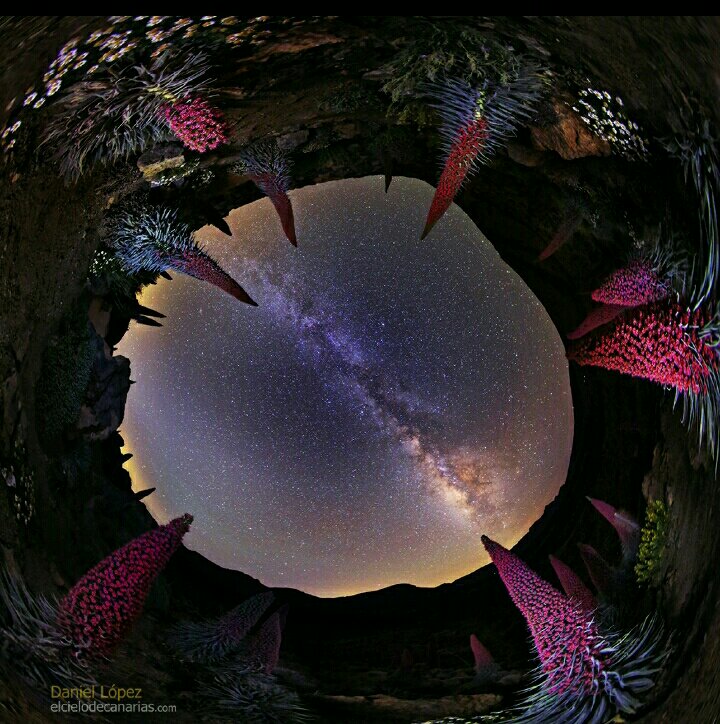
What bizarre planet are these alien creatures from? It’s only planet Earth, of course. The planet’s home galaxy the Milky Way stretches across a dark sky in the panoramic, fisheye all-sky projection composed with a wide lens. But the imposing forms gazing skyward probably look strange to many denizens of Earth. Found on the Canary Island of Tenerife in the Teide National Park, they are red tajinastes, flowering plants that grow to a height of up to 3 meters. Among the rocks of the volcanic terrain, tajinastes bloom in spring and early summer and then die after a week or so as their seeds mature. A species known as Echium wildpretii, the terrestrial life forms were individually lit by flashlight during the wide-angle exposures.
2.Moons Near Jupiter
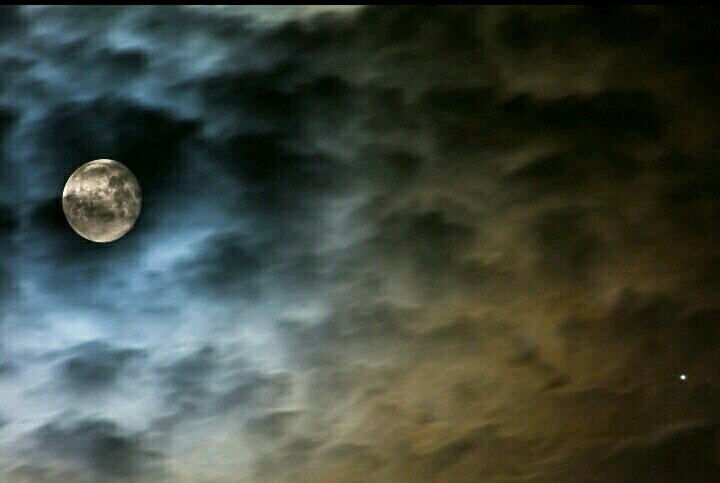
On May 20, a nearly Full Moon and Jupiter shared this telephoto field of view. Captured when a passing cloud bank dimmed the moonlight, the single exposure reveals the familiar face of our fair planet’s own large natural satellite, along with bright Jupiter (lower right) and some of its Galilean moons. Lined up left to right the tiny pinpricks of light near Jupiter are Ganymede, Europa, [Jupiter] and Callisto. (That’s not just dust on your screen …) Closer and brighter, our own natural satellite appears to loom large. But Ganymede, and Callisto are physically larger than Earth’s Moon, while water world Europais only slightly smaller. In fact, of the Solar System’s six largest planetary satellites, Saturn’s moon Titan is missing from the scene and a fourth Galilean moon, Io, is hidden by our ruling gas giant.
3.Deep Field: Nebulae of Sagittarius
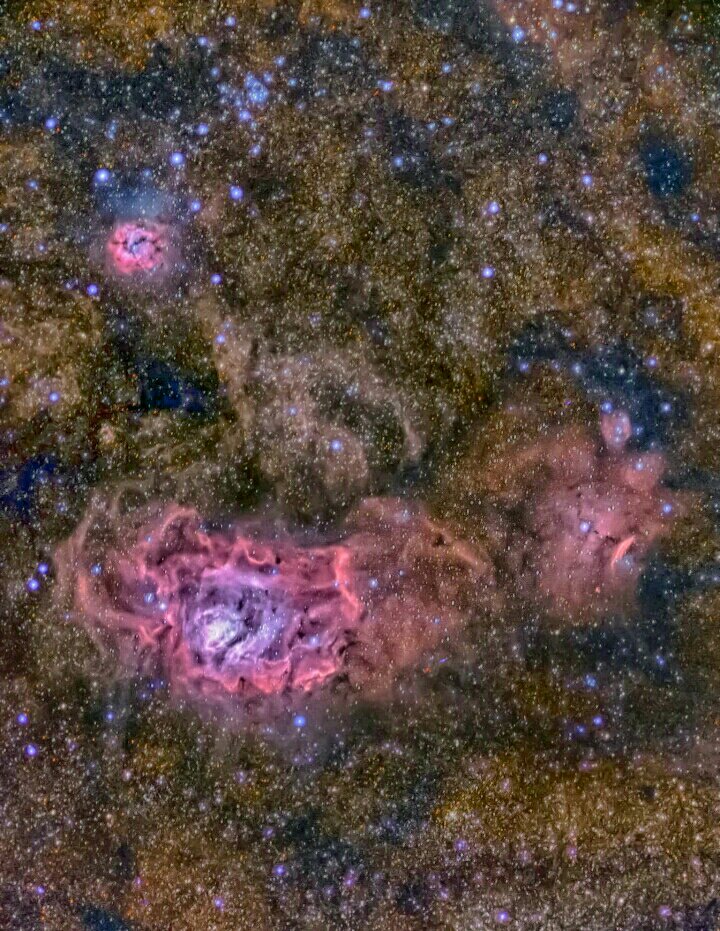
These three bright nebulae are often featured on telescopic tours of the constellationSagittarius and the crowded starfields of thecentral Milky Way. In fact, 18th century cosmic tourist Charles Messier cataloged two of them; M8, the large nebula just left of center, and colorful M20 on the top left. The third emission region includes NGC 6559 and can be found to the right of M8. All three arestellar nurseries about five thousand light-years or so distant. Over a hundred light-years across, the expansive M8 is also known as the Lagoon Nebula. M20’s popular moniker is the Trifid. Glowing hydrogen gas creates the dominant red color of theemission nebulae. In striking contrast, blue hues in the Trifid are due to dust reflected starlight. Recently formed bright blue stars are visible nearby. The colorful composite skyscape was recorded in 2018 in Teide National Park in the Canary Islands, Spain.
4.RS Puppis
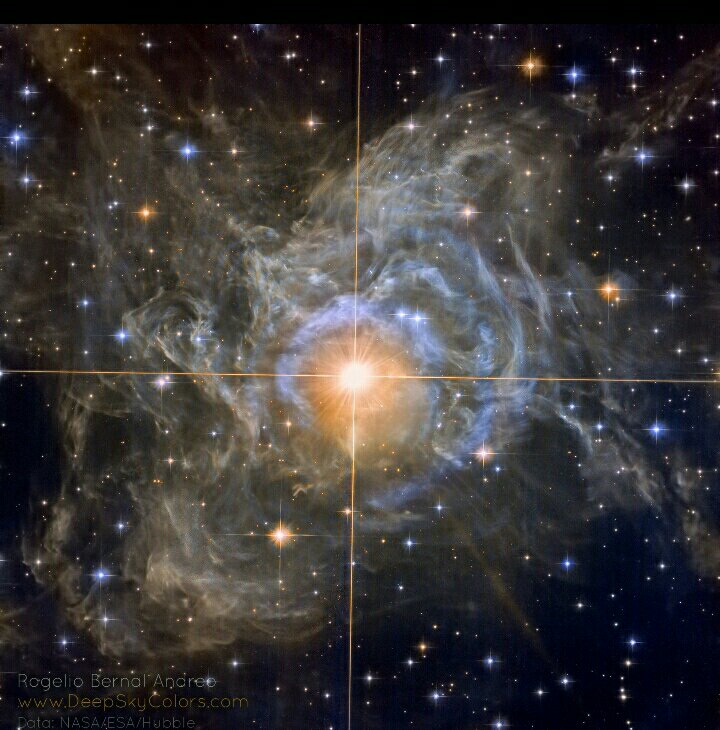
Pulsating RS Puppis, the brightest star in the image center, is some ten times more massive than our Sun and on average 15,000 times more luminous. In fact, RS Pup is a Cepheid variable star, a class of stars whosebrightness is used to estimate distances to nearby galaxies as one of the first steps in establishing the cosmic distance scale. As RS Pup pulsates over a period of about 40 days, its regular changes in brightness are also seen along its surrounding nebuladelayed in time, effectively a light echo. Using measurements of the time delay and angular size of the nebula, the known speed of lightallows astronomers to geometrically determine the distance to RS Pup to be 6,500 light-years, with a remarkably small error of plus or minus 90 light-years. An impressive achievement for stellar astronomy, the echo-measured distance also more accurately establishes the true brightness of RS Pup, and by extension other Cepheid stars, improving the knowledge of distances to galaxies beyond the Milky Way.
5.Galaxy Blazes With New Stars Born From Close Encounter
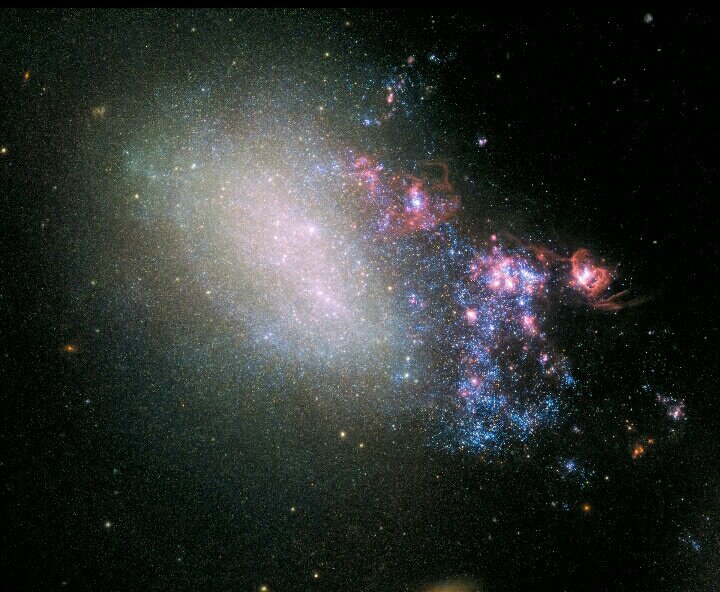
The irregular galaxy NGC 4485 shows all the signs of having been involved in a hit-and-run accident with a bypassing galaxy. Rather than destroying the galaxy, the chance encounter is spawning a new generation of stars, and presumably planets.
The right side of the galaxy is ablaze with star formation, shown in the plethora of young blue stars and star-incubating pinkish nebulas. The left side, however, looks intact. It contains hints of the galaxy’s previous spiral structure, which, at one time, was undergoing normal galactic evolution.
The larger culprit galaxy, NGC 4490, is off the bottom of the frame. The two galaxies sideswiped each other millions of years ago and are now 24,000 light-years apart. The gravitational tug-of-war between them created rippling patches of higher-density gas and dust within both galaxies. This activity triggered a flurry of star formation.
This galaxy is a nearby example of the kind of cosmic bumper-car activity that was more common billions of years ago when the universe was smaller and galaxies were closer together.
NGC 4485 lies 25 million light-years away in the northern constellation Canes Venatici (the Hunting Dogs).
This new image, captured by Hubble’s Wide Field Camera 3 (WFC3), provides further insight into the complexities of galaxy evolution.
The Hubble Space Telescope is a project of international cooperation between NASA and ESA (European Space Agency). NASA’s Goddard Space Flight Center in Greenbelt, Maryland, manages the telescope. The Space Telescope Science Institute (STScI) in Baltimore, Maryland, conducts Hubble science operations. STScI is operated for NASA by the Association of Universities for Research in Astronomy in Washington, D.C.
6.Dark Skies: Turn on the Night
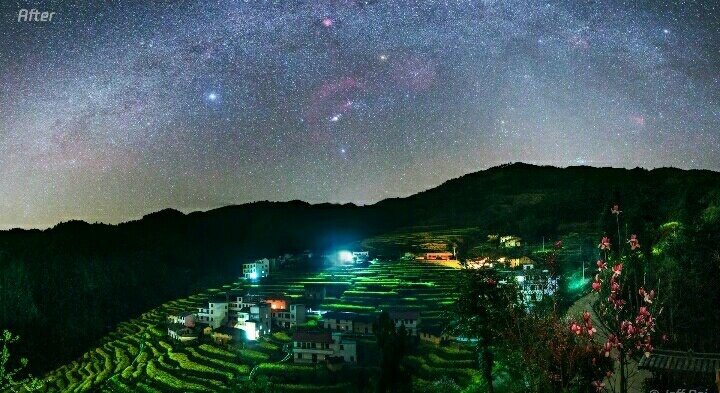
Have you ever experienced a really dark night sky? One common and amazing feature is the glowing band of our Milky Way galaxy stretching from horizon to horizon. If you live in or near a big city, though, you might not know this because city lights reflecting off the Earth’s atmosphere could only allow you to see the Moon and a few stars. Today, however, being UNESCO‘s International Day of Light, the International Astronomical Unionis asking people to Turn on the Night by trying to better understand, and in the future better reduce, light pollution. You can practice even now by going to the main APOD website at NASA and hovering your cursor over theBefore image. The After picture that comes up is a panorama of four exposures taken with the same camera and from the same location, showing what happened recently inChina when people in Kaihua County decided to turn down many of their lights. Visible in the Before picture are the stars Sirius (left of center) and Betelgeuse, while visible in theAfter picture are thousands of stars with the arching band of our Milky Way Galaxy. Humanity has lived for millennia under a dark night sky, and connecting to it hasimportance for both natural and cultural heritage.
7.Young Star Cluster Trumpler 14 from Hubble
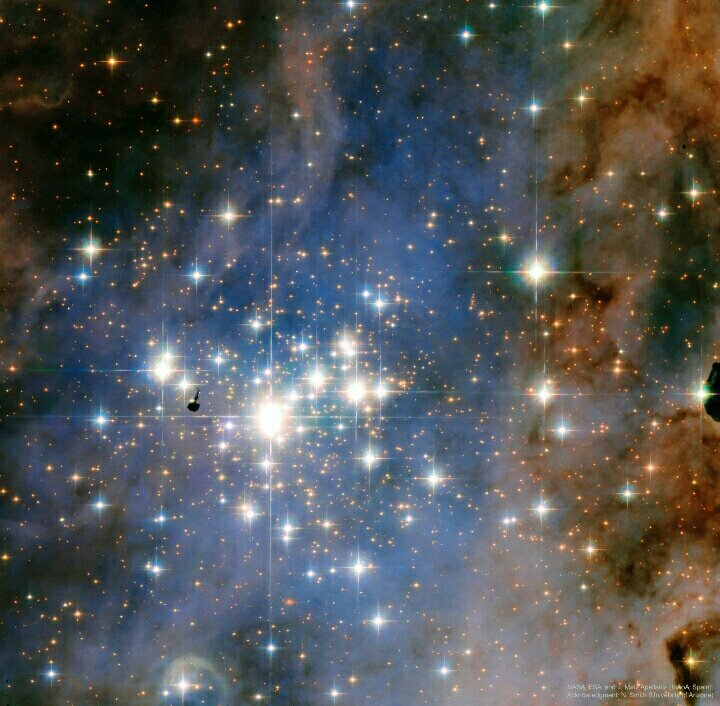
Why does star cluster Trumpler 14 have so many bright stars? Because it is so young. Many cluster stars have formed only in the past 5 million years and are so hot they emitdetectable X-rays. In older star clusters, most stars this young have already died — typicallyexploding in a supernova — leaving behind stars that are fainter and redder. Trumpler 14spans about 40 light years and lies about 9,000 light years away on the edge of the famous Carina Nebula. A discerning eye can spot two unusual objects in this detailed 2006 image of Trumpler 14 by the Hubble Space Telescope. First, a dark cloud just left of center may be a planetary system trying to form before being destroyed by the energetic winds of Trumpler 14‘s massive stars. Second is the arc at the bottom left, which one hypothesis holds is the supersonic shock wave of a fast star ejected 100,000 years ago from a completely different star cluster.
8.Milky Way, Launch, and Landing
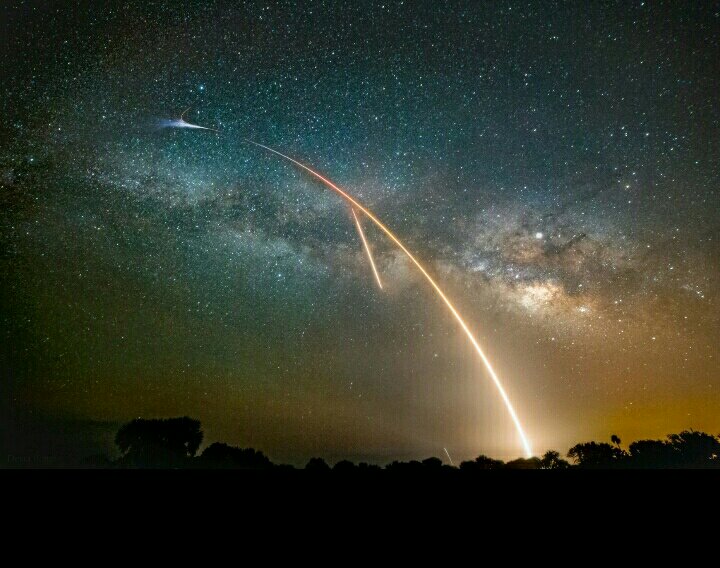
The Milky Way doesn’t look quite this colorful and bright to the eye, but a rocket launch does. So a separate deep exposure with a sensitive digital camera was used in this composite skyscape to bring out our galaxy’s central crowded starfields and cosmic dust clouds. In the scene from Merritt Island National Wildlife Refuge, a nine minute long exposure begun about 20 minutes after the Miky Way image recorded a rocket launchand landing. The Falcon 9 rocket, named for the Millennium Falcon of Star Wars fame, appropriately launched a Dragon resupply ship to the International Space Station in the early morning hours of May the 4th. The plume and flare at the peak of the launch arc mark the rocket’s first stage boost back burn. Two shorter diagonal streaks are the rocket engines bringing the Falcon 9 stage back to an offshore landing on autonomous drone ship Of course I Still Love You.
For more amazing facts, follow my blog
 space science



Leave a comment